
Educating the Masses - the Lancastrian System of Education

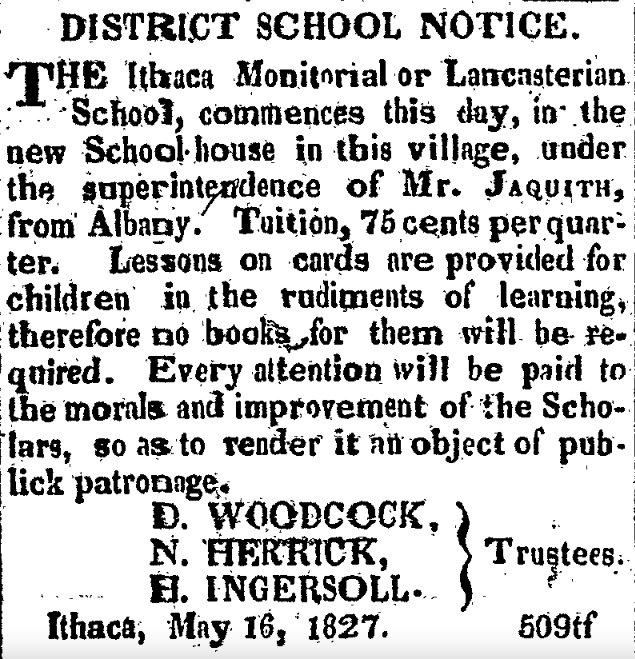
Jonathan Jasper Wright left Springville in 1858 to attend the Lancasterian School in Ithaca, New York, which he attended until 1860. Lancastrian education emerged in the UK in the early 1800’s, designed by Joseph Lancaster, a self-taught educator who sought to provide education to the masses through rigorous but cost-effective schools.
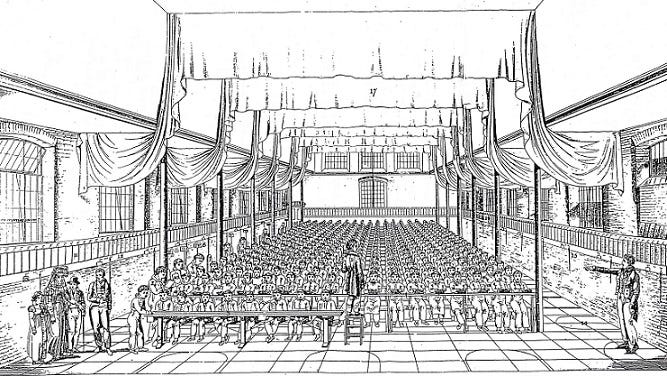
Lancastrian education used the monitorial system, in which a single head teacher supervised, in a large single room, dozens or even hundreds students of multiple ages and abilities. Older students (known as monitors) were responsible for training the younger students, which allowed the school to operate with a small budget, and at the same time leverage the educational value of deepening the learning of the monitors through teaching the material themselves.
Prior to 1800, education in Britain (and most other countries) was limited to the elites. Education for working-class children was ad hoc, involving some schooling in Charity Schools, so-called “Pettie” schools, and Sunday schools dominated by studying Scripture. Moreover it conflicted with the need of the burgeoning Industrial Revolution for child labor. It was not until 1840 that a universal system of education in Britain began to emerge.
Into this void came Joseph Lancaster. We’ll dive into Lancaster and his system in future posts - including how it may have influenced Jonathan Jasper Wright as he himself embarked on a lifelong effort to educate others.
Dates for JJW attendance at Lancasterian School from “Another Witness,” profile of JJW, The News and Herald, Winnsboro, SC, August 29, 1878.
Source note: many of the details of the Lancastrian system and the life of Joseph Lancaster are adapted from “Joseph Lancaster: The Poor Child’s Friend,” by Joyce Taylor. Kent, England: The Campanile Press, 1996.